10-Q: Quarterly report [Sections 13 or 15(d)]
Published on August 13, 2026
UNITED STATES
SECURITIES AND EXCHANGE COMMISSION
Washington, D.C. 20549
FORM 10-Q
(Mark One)
QUARTERLY REPORT PURSUANT TO SECTION 13 OR 15(d) OF THE SECURITIES EXCHANGE ACT OF 1934
For the quarterly period ended June 30, 2026
or
TRANSITION REPORT PURSUANT TO SECTION 13 OR 15(d) OF THE SECURITIES EXCHANGE ACT OF 1934
For the transition period from to
Commission file number: 001-35776
(Exact name of registrant as specified in its charter)
| State of | | |
| (State or other jurisdiction of incorporation or organization) | | (I.R.S. Employer Identification Number) |
(Address of principal executive offices, including zip code)
(Registrant’s telephone number, including area code)
Securities registered pursuant to Section 12(b) of the Act:
| Title of each class | Trading Symbol(s) |
Name of each exchange on which
registered |
| | | |
Indicate by check mark whether the registrant (1) has filed all reports required to be filed by Section 13 or 15(d) of the Securities Exchange Act of 1934 during the preceding 12 months (or for such shorter period that the registrant was required to file such reports), and (2) has been subject to such filing requirements for the past 90 days. Yes ☒ No ☐
Indicate by check mark whether the registrant has submitted electronically every Interactive Data File required to be submitted pursuant to Rule 405 of Regulation S-T (§232.405 of this chapter) during the preceding 12 months (or for such shorter period that the registrant was required to submit such files). Yes ☒ No ☐
Indicate by check mark whether the registrant is a large accelerated filer, an accelerated filer, a non-accelerated filer, a smaller reporting company, or an emerging growth company. See the definitions of “large accelerated filer,” “accelerated filer,” “smaller reporting company,” and “emerging growth company” in Rule 12b-2 of the Exchange Act.
| Large accelerated filer | ☐ | Accelerated filer | ☐ |
| | ☒ | Smaller reporting company | |
| Emerging growth company | | | |
If an emerging growth company, indicate by check mark if the registrant has elected not to use the extended transition period for complying with any new or revised financial accounting standards provided pursuant to Section 13(a) of the Exchange Act. ☐
Indicate by check mark whether the registrant is a shell company (as defined in Rule 12b-2 of the Exchange Act). Yes ☐ No ☒
The number of outstanding shares of common stock of the registrant, par value per share of $0.0001, as of August 11, 2026, was 21,035,930 .
GRACE THERAPEUTICS, INC.
QUARTERLY REPORT ON FORM 10-Q
For the Quarter Ended June 30, 2026
| Table of Contents | ||
| Page | ||
| PART I. FINANCIAL INFORMATION | ||
|
Item 1.
|
6 | |
|
Item 2.
|
21 | |
|
Item 3.
|
36 | |
|
Item 4.
|
36 | |
| PART II. OTHER INFORMATION | ||
|
Item 1.
|
36 | |
|
Item 1A.
|
37 | |
|
Item 2.
|
37 | |
|
Item 3.
|
37 | |
|
Item 4.
|
37 | |
|
Item 5.
|
37 | |
|
Item 6.
|
37 | |
SPECIAL NOTE REGARDING FORWARD-LOOKING STATEMENTS
This quarterly report contains information that may be forward-looking statements within the meaning of U.S. federal securities laws and forward-looking information within the meaning of Canadian securities laws, both of which we refer to in this quarterly report as forward-looking information. Forward- looking statements can be identified by the use of terms such as “may,” “will,” “should,” “expect,” “plan,” “anticipate,” “believe,” “intend,” “estimate,” “predict,” “potential,” “continue” or other similar expressions concerning matters that are not statements about historical facts. Forward-looking statements in this quarterly report include, among other things, information, or statements about:
•
our ability to build a late-stage pharmaceutical company focused in rare and orphan diseases and, on developing and commercializing products that improve clinical outcomes using our novel drug delivery technologies;
•
our ability to apply new proprietary formulations to existing pharmaceutical compounds to achieve enhanced efficacy, faster onset of action, reduced side effects, and more convenient drug delivery that can result in increased patient compliance;
•
the potential for our drug candidates to receive exclusivity from the U.S. Food and Drug Administration (“FDA”) or regulatory approval under the Section 505(b)(2) regulatory pathway under the Federal Food, Drug and Cosmetic Act (“FDCA”);
•
our ability, plan and timing to address the items cited
in the Complete Response Letter (“CRL”) from the FDA related to GTx-104; our
resubmission of a new drug application (“NDA”) for GTx-104 under Section
505(b)(2) of the FDCA; the acceptance of such resubmission of an NDA by the
FDA; and the timing and ability to receive FDA approval for marketing GTx-104;
•
the future prospects of our GTx-104 drug candidate, including but not limited to GTx-104’s potential to be administered to improve the management of hypotension in patients with aneurysmal subarachnoid hemorrhage (“aSAH”); the ability of GTx-104 to achieve a pharmacokinetic (“PK”) and safety profile similar to the oral capsule form of nimodipine; GTx-104’s potential to provide improved bioavailability; and GTx-104’s potential to achieve pharmacoeconomic benefit over the oral capsule form of nimodipine;
•
our plan to maximize the value of our de-prioritized drug candidates, GTx-102 and GTx-101, including through potential licensing or sale of those drug candidates;
•
the future prospects of our GTx-102 drug candidate, including but not limited to GTx-102’s potential to provide clinical benefits to decrease symptoms associated with Ataxia Telangiectasia; GTx-102’s potential ease of drug administration; the timing and outcomes of a Phase 3 efficacy and safety study for GTx-102; the timing of an NDA filing for GTx-102 under Section 505(b)(2) of the FDCA; and the timing and ability to receive FDA approval for marketing GTx-102;
•
the future prospects of our GTx-101 drug candidate, including but not limited to GTx-101’s potential to be administered to postherpetic neuralgia (“PHN”) patients to treat the severe nerve pain associated with the disease; assumptions about the biphasic delivery mechanism of GTx-101, including its potential for rapid onset and continuous pain relief for up to eight hours; and the timing and outcomes of single ascending dose/multiple ascending dose and PK bridging studies, and a Phase 2 and Phase 3 efficacy and safety study; the timing of an NDA filing for GTx-101 under Section 505(b)(2) of the FDCA; and the timing and ability to receive FDA approval for marketing GTx-101;
•
the quality of our clinical data, the cost and size of our development programs, expectations and forecasts related to our target markets and the size of our target markets; the cost and size of our commercial infrastructure and manufacturing needs in the United States, European Union, and the rest of the world; and our expected use of a range of third-party contract research organizations (“CROs”) and contract manufacturing organizations (“CMOs” or “contract
manufacturer”) at multiple locations;
•
expectations and forecasts related to our intellectual property portfolio, including but not limited to the probability of receiving orphan drug exclusivity from the FDA for our leading pipeline drug candidates; our patent portfolio strategy; and outcomes of our patent filings and extent of patent protection;
•
our intellectual property position and duration of our patent rights;
•
our strategy, future operations, prospects and the plans of our management with a goal to enhance shareholder value;
•
our need for additional financing, and our estimates regarding our operating runway and timing for future financing and capital requirements;
•
our expectations regarding our financial performance, including our costs and expenses, liquidity, and capital resources;
•
our projected capital requirements to fund our anticipated expenses; and
•
our ability to commercialize GTx-104 in the United States or establish strategic partnerships or commercial collaborations or obtain non-dilutive funding.
Although the forward-looking statements in this quarterly report are based upon what we believe are reasonable assumptions, you should not place undue reliance on those forward-looking statements since actual results may vary materially from them.
In addition, the forward-looking statements in this quarterly report are subject to a number of known and unknown risks, uncertainties and other factors, many of which are beyond our control, that could cause our actual results and developments to differ materially from those that are disclosed in or implied by the forward-looking statements, including, among others:
•
we are heavily dependent on the success of our lead drug candidate, GTx-104;
•
we may not be able to sufficiently address the items cited in the FDA’s CRL
for GTx-104;
•
we may not be able to resubmit the NDA for GTx-104 in a timely manner or otherwise, or resubmission may not result in approval by the FDA;
•
our contract manufacturer may not be able to
remediate the deficiencies identified during a current Good Manufacturing
Practice (“cGMP”) inspection that were cited in the FDA’s CRL for GTx-104 in a timely or
satisfactory manner or demonstrate ongoing compliance with applicable
regulatory requirements, including cGMP;
•
the timing of any FDA reinspection of our current
contract manufacturer, and that facility’s
compliance status, are determined by the FDA and outside our control, and the
FDA will not approve the NDA while the facility remains in an unacceptable
compliance status;
•
our second, U.S.-based contract manufacturer will need to generate its own stability and analytical data and successfully complete a product-specific pre-approval inspection before it can support approval, which will take time and may not succeed;
•
our resubmission is expected to require additional non-clinical (toxicology) studies, which may not be completed on the timeline, or with the results, we expect;
•
the FDA may require that our resubmission
comprehensively address all items cited in the CRL at the time of resubmission,
and an incomplete resubmission could result in another CRL or review delay;
•
the FDA's positions, including as reflected in the official minutes of our Type A meeting, may be less favorable to us than we currently anticipate, and significant questions regarding our resubmission may remain unresolved;
•
we may require additional capital to fund the activities necessary to resubmit the NDA and support FDA review, and such capital may not be available on acceptable terms, or at all;
•
clinical development is a lengthy and expensive process with an uncertain outcome, and results of earlier studies and trials may not be predictive of future trial results. Failure can occur at any stage of clinical development;
•
we are subject to uncertainty relating to healthcare reform measures and reimbursement policies that, if not favorable to our drug candidates, could hinder or prevent our drug candidates’ commercial success;
•
if we are unable to establish sales and marketing capabilities or enter into agreements with third parties to market and sell our drug products, if approved, we may be unable to generate any revenue;
•
if we are unable to differentiate our drug products from branded reference drugs or existing generic therapies for similar treatments, or if the FDA or other applicable regulatory authorities approve products that compete with any of our drug products, our ability to successfully commercialize our drug products would be adversely affected;
•
our success depends in part upon our ability to protect our intellectual property for our drug candidates;
•
intellectual property rights do not necessarily address all potential threats to our competitive advantage;
•
we do not have internal manufacturing capabilities, and if we fail to develop and maintain supply relationships with various third-party manufacturers, or if such third parties fail to provide us with sufficient quantities of active pharmaceutical ingredients, excipients or drug products, or fail to do so at acceptable quality levels or prices or fail to maintain or achieve satisfactory regulatory compliance, we may be unable to develop or commercialize our drug candidates;
•
the design, development, manufacture, supply, and distribution of our drug candidates are highly regulated and technically complex; and
•
the other risks and uncertainties identified in Item 1A. Risk Factors and Item 7. Management’s Discussion and Analysis of Financial Condition and Results of Operations included in our Annual Report on Form 10-K for the year ended March 31, 2026, filed with the SEC on June 18, 2026.
All of the forward-looking statements in this quarterly report are qualified by this cautionary statement. There can be no guarantee that the results or developments that we anticipate will be realized or, even if substantially realized, that they will have the consequences or effects on our business, financial condition, or results of operations that we anticipate. As a result, you should not place undue reliance on forward-looking statements. Except as required by applicable law, we do not undertake to update or amend any forward-looking statements, whether as a result of new information, future events or otherwise. All forward-looking statements are made as of the date of this quarterly report.
We express all amounts in this quarterly report in U.S. dollars, except where otherwise indicated. References to “$” and “U.S.$” are to U.S. dollars.
Except as otherwise indicated, references in this quarterly report to “Grace,” “Grace Therapeutics,” “Acasti,” “the Company,” “we,” “us,” and “our” refer to Grace Therapeutics, Inc. (formerly known as Acasti Pharma, Inc.) and its consolidated subsidiary.
PART I. FINANCIAL INFORMATION
Unaudited Condensed Consolidated Financial Statements
| 7 | |
| 8 | |
| 9 | |
| 10 | |
| 11 |
GRACE THERAPEUTICS, INC.
(Unaudited)
| June 30, 2026 | March 31, 2026 | |||||||
|
(Expressed in thousands except share data)
|
$ | $ | ||||||
|
Assets
|
||||||||
|
Current assets:
|
||||||||
|
Cash and cash equivalents
|
||||||||
|
Receivables
|
||||||||
|
Prepaid expenses
|
||||||||
|
Total current assets
|
||||||||
|
Equipment, net
|
||||||||
|
Intangible assets
|
||||||||
|
Goodwill
|
||||||||
|
Total assets
|
||||||||
|
Liabilities and Stockholders’ equity
|
||||||||
|
Current liabilities:
|
||||||||
|
Trade and other payables
|
||||||||
|
Total current liabilities
|
||||||||
|
Deferred tax liability
|
||||||||
|
Total liabilities
|
||||||||
|
Commitments and contingencies (Note 11)
|
||||||||
|
Stockholders’ equity:
|
||||||||
| Preferred stock, $ |
||||||||
| Common stock, $ |
||||||||
|
Additional paid-in capital
|
||||||||
|
Accumulated other comprehensive loss
|
( | ) | ( | ) | ||||
|
Accumulated deficit
|
( | ) | ( | ) | ||||
|
Total stockholders' equity
|
||||||||
|
Total liabilities and stockholders’ equity
|
||||||||
See accompanying notes to condensed consolidated financial statements.
GRACE THERAPEUTICS, INC.
(Unaudited)
| Three months ended | ||||||||
| June 30, 2026 | June 30, 2025 | |||||||
|
(Expressed in thousands, except share and per share data)
|
$ | $ | ||||||
|
Operating expenses
|
||||||||
|
Research and development expenses
|
( | ) | ( | ) | ||||
|
General and administrative expenses
|
( | ) | ( | ) | ||||
|
Impairment of intangible assets
|
( | ) | ||||||
|
Loss from operating activities
|
( | ) | ( | ) | ||||
|
Foreign exchange (loss) gain
|
( | ) | ||||||
|
Change in fair value of derivative warrant liabilities
|
( | ) | ||||||
|
Interest and other income, net
|
||||||||
|
Total other income (expense), net
|
( | ) | ||||||
|
Loss before income tax benefit
|
( | ) | ( | ) | ||||
|
Income tax benefit
|
||||||||
|
Net loss and total comprehensive loss
|
( | ) | ( | ) | ||||
|
Basic and diluted loss per share
|
( | ) | ( | ) | ||||
|
Weighted-average number of shares outstanding
|
||||||||
See accompanying notes to condensed consolidated financial statements.
GRACE THERAPEUTICS, INC.
(Unaudited)
|
| Common stock | |||||||||||||||||||||||
|
(Expressed in thousands except share data)
|
Number
|
Amount
|
Additional paid-in capital |
Accumulated other comprehensive loss |
Accumulated deficit |
Total stockholders' equity | ||||||||||||||||||
|
Balance, March 31, 2026
|
( | ) | ( | ) | ||||||||||||||||||||
|
Issuance of common stock upon cashless exercise of pre-funded warrants
|
||||||||||||||||||||||||
|
Net loss
|
— | ( | ) | ( | ) | |||||||||||||||||||
|
Stock-based compensation
|
— | |||||||||||||||||||||||
|
Balance at June 30, 2026
|
( | ) | ( | ) | ||||||||||||||||||||
|
| Common stock | |||||||||||||||||||||||
|
(Expressed in thousands except share data)
|
Number
| Amount |
Additional paid-in capital |
Accumulated other comprehensive loss |
Accumulated deficit |
Total stockholders' equity | ||||||||||||||||||
|
Balance, March 31, 2025
|
( | ) | ( | ) | ||||||||||||||||||||
|
Issuance of common stock upon cashless exercise of pre-funded warrants
|
||||||||||||||||||||||||
|
Net loss
|
— | ( | ) | ( | ) | |||||||||||||||||||
|
Stock-based compensation
|
— | |||||||||||||||||||||||
|
Balance at June 30, 2025
|
( | ) | ( | ) | ||||||||||||||||||||
See accompanying notes to condensed consolidated financial statements.
GRACE THERAPEUTICS, INC.
(Unaudited)
| Three months ended | ||||||||
|
June 30, 2026 |
June 30, 2025 | |||||||
|
(Expressed in thousands)
|
$ | $ | ||||||
|
Cash flows from operating activities:
|
||||||||
|
Net loss
|
( | ) | ( | ) | ||||
|
Adjustments:
|
||||||||
|
Depreciation expense
|
||||||||
|
Stock-based compensation
|
||||||||
|
Impairment of intangible assets
|
||||||||
|
Change in fair value of derivative warrant liabilities
|
||||||||
|
Changes in operating assets and liabilities:
|
||||||||
|
Receivables
|
||||||||
|
Prepaid expenses
|
( | ) | ( | ) | ||||
|
Trade and other payables
|
( | ) | ||||||
|
Net cash used in operating activities
|
( | ) | ( | ) | ||||
|
Cash flows from financing activities:
|
||||||||
|
Payment of stock issuance costs
|
( | ) | ||||||
|
Net cash used in financing activities
|
( | ) | ||||||
|
Net decrease in cash and cash equivalents
|
( | ) | ( | ) | ||||
|
Cash and cash equivalents, beginning of period
|
||||||||
|
Cash and cash equivalents, end of period
|
||||||||
|
Cash and cash equivalents are comprised of:
|
||||||||
|
Cash
|
||||||||
|
Cash equivalents
|
||||||||
See accompanying notes to condensed consolidated financial statements.
GRACE THERAPEUTICS, INC.
(Unaudited)
(Expressed in thousands except share and per share data)
1. Nature of operations
General
Grace Therapeutics, Inc. (formerly known as Acasti Pharma Inc.) (“Acasti Delaware” or the “Company”), is a Delaware corporation that, as further described below, previously existed under the laws of the Province of Québec, Canada (“Acasti Québec”), before changing its jurisdiction on October 1, 2024 to the Province of British Columbia, Canada (“Acasti British Columbia”). On October 7, 2024, Acasti British Columbia changed its jurisdiction to the State of Delaware in the United States of America. Effective October 28, 2024, the Company changed its corporate name to Grace Therapeutics, Inc.
Liquidity and Financial Condition
The Company has incurred operating losses and negative cash flows from operations in each period since its inception. The Company expects to incur significant expenses and continued operating losses for the foreseeable future.
In
May 2023, the Company implemented a strategic realignment plan to enhance
shareholder value that resulted in the Company engaging a new management team,
streamlining its research and development activities, and greatly reducing its
workforce. Following the realignment, the Company is a smaller, more focused
organization, based in the United States, and concentrated on its development
of its lead product candidate GTx-104. In June 2026, following continued
evaluation of strategic priorities and focus on GTx-104, the Company impaired
the $13,533 capitalized carrying value of GTx-102 and GTx-101 in process
research and development (“IPR&D”), which is recorded within operating
expenses in the condensed consolidated statements of loss and comprehensive
loss for the three months ended June 30, 2026. In August 2026, the Company
completed a private placement of Company common stock, par value $0.0001 per
share (“Common Stock”) with certain institutional and accredited
investors. Net proceeds to the Company were approximately $9,100 . Refer to Note 12, Subsequent Events for additional
information.
As of August 11, 2026, cash and cash equivalents were $22,231 . The
Company plans to use its cash and cash equivalents towards resolving the items
cited in the FDA’s CRL, working capital and other general corporate purposes.
The Company believes its existing cash and cash equivalents will be sufficient
to sustain planned operations, including the activities to address the items
cited in the CRL, through at least 12 months from the issuance date of these
unaudited condensed financial statements.
The
Company will require additional capital to fund its daily operating needs. The
Company does not expect to generate revenue from product sales unless and until
it successfully completes drug development and obtains regulatory approval,
which is subject to significant uncertainty. To date, the Company has financed
its operations primarily through public offerings and private placements of its
common equity, warrants and convertible debt and the proceeds from warrant
exercises and research tax credits. Until such time that the
Company can generate significant revenue from drug product sales, if ever, it
will require additional financing, which is expected to be sourced from a
combination of public or private equity or debt financing or other non-dilutive
sources, which may include fees, milestone payments and royalties from
collaborations with third parties. Arrangements with collaborators or others
may require the Company to relinquish certain rights related to its
technologies or drug product candidates. Adequate additional financing may not
be available to the Company on acceptable terms, or at all. The Company’s
inability to raise capital as and when needed could have a negative impact on
its financial condition and its ability to pursue its business strategy. The
Company plans to raise additional capital in order to maintain adequate
liquidity. Negative results from studies or trials, if any, the timing and
ability to receive FDA approval for marketing the
Company’s drug candidates or depressed prices of the Company’s
stock could impact the Company’s ability to raise additional financing. Raising
additional equity capital is subject to market conditions that are not within
the Company’s control. If the Company is unable to raise additional funds, the
Company may not be able to realize its assets and discharge its liabilities in
the normal course of business.
The Company remains subject to risks similar to other development stage companies in the biopharmaceutical industry, including compliance with government regulations, protection of proprietary technology, dependence on third-party contractors and consultants and potential product liability, among others. Please refer to the risk factors included in Part 1, Item 1A of the Company’s Annual Report on Form 10-K for the year ended March 31, 2026, filed with the SEC on June 18, 2026 (the “Annual Report”).
2. Summary of significant accounting policies
Basis of presentation
The accompanying unaudited condensed consolidated financial statements have been prepared in accordance with generally accepted accounting principles in the United States of America (“U.S. GAAP”) for interim financial information and with the instructions to Form 10-Q and Article 8 of Regulation S-X under the Securities Exchange Act of 1934. Any reference in these notes to applicable guidance is meant to refer to the authoritative U.S. GAAP as found in the Accounting Standards Codification (“ASC”) and as amended by Accounting Standards Updates (“ASU”) of the Financial Accounting Standards Board (“FASB”).
The unaudited condensed consolidated financial statements have been prepared on the same basis as the audited annual consolidated financial statements as of and for the year ended March 31, 2026, and, in the opinion of management, reflect all adjustments, consisting of normal recurring adjustments, necessary for the fair presentation of the Company’s consolidated financial position as of June 30, 2026, the consolidated results of its operations for the three months ended June 30, 2026 and 2025, its statements of stockholders’ equity for the three months ended June 30, 2026 and 2025, and its consolidated cash flows for the three months ended June 30, 2026 and 2025.
These unaudited condensed consolidated financial statements should be read in conjunction with the Company’s audited consolidated financial statements and the accompanying notes for the year ended March 31, 2026 included in the Company’s Annual Report. The condensed consolidated balance sheet data as of March 31, 2026 presented for comparative purposes was derived from the Company’s audited consolidated financial statements. The results for the three months ended June 30, 2026 are not necessarily indicative of the operating results to be expected for the full year or for any other subsequent interim period.
The Company’s significant accounting policies are disclosed in the audited consolidated financial statements for the year ended March 31, 2026 included in the Annual Report. There have been no changes to the Company’s significant accounting policies since the date of the audited consolidated financial statements for the year ended March 31, 2026 included in the Annual Report.
Use of estimates
The preparation of these unaudited condensed consolidated financial statements in conformity with U.S. GAAP requires management to make estimates and assumptions that affect the reported amounts of assets, liabilities, income, and expenses. Actual results may differ from these estimates.
Estimates are based on management’s best knowledge of current events and actions that management may undertake in the future. Estimates and underlying assumptions are reviewed on an ongoing basis. Revisions to accounting estimates are recognized in the period in which the estimates are revised and in any future periods affected.
Estimates and assumptions include the measurement of stock-based compensation, derivative warrant liabilities, accruals for research and development contracts and contract organization agreements, and valuation of intangibles and goodwill. Estimates and assumptions are also involved in determining the extent to which research and development expenses qualify for research and development tax credits. The Company recognizes tax credits once it has reasonable assurance that they will be realized.
Recent accounting pronouncements
In November 2024, the FASB issued ASU 2024-03, Income Statement—Reporting Comprehensive Income—Expense Disaggregation Disclosures (Subtopic 220-40) (“ASU 2024-03”), to improve the disclosures about a public business entity’s expenses and address requests from investors for more detailed information about the types of expenses (including purchases of inventory, employee compensation, depreciation, amortization and depletion) in commonly presented expense captions (such as cost of sales, SG&A and research and development).
ASU 2024-03 applies to all public business entities and is effective for annual reporting periods beginning after December 15, 2026 and interim reporting periods within annual reporting periods beginning after December 15, 2027. The requirements will be applied prospectively with the option for retrospective application. Early adoption is permitted. The Company is currently evaluating the effect of adopting this new guidance on its consolidated financial statements and disclosures. The Company does not expect that the adoption of ASU 2024-03 will have a material impact on its consolidated financial statements and disclosures.
The Company has considered all other recent accounting pronouncements and concluded that they are either not applicable to the Company’s business or that the effect is not expected to be material to the consolidated financial statements as a result of future adoption.
3. Fair value measurements
Assets and liabilities measured at fair value on a recurring basis as of June 30, 2026 are as follows:
| Total |
Quoted prices in active markets (Level 1) |
Significant other observable inputs (Level 2) |
Significant unobservable inputs (Level 3) | |||||||||||||
| $ | $ | $ | $ | |||||||||||||
|
Assets
|
||||||||||||||||
|
Treasury bills classified as cash equivalents
|
||||||||||||||||
|
Total assets
|
||||||||||||||||
|
Total liabilities
|
||||||||||||||||
Assets and liabilities measured at fair value on a recurring basis as of March 31, 2026 are as follows:
| Total |
Quoted prices in active markets (Level 1) |
Significant other observable inputs (Level 2) |
Significant unobservable inputs (Level 3) | |||||||||||||
| $ | $ | $ | $ | |||||||||||||
|
Assets
|
||||||||||||||||
|
Treasury bills classified as cash equivalents
|
||||||||||||||||
|
Total assets
|
||||||||||||||||
|
Total liabilities
|
||||||||||||||||
There were no changes in valuation techniques or transfers between Levels 1, 2 or 3 during the three months ended June 30, 2026.
4. Intangible assets and goodwill
Individual IPR&D
projects and goodwill are tested for impairment on an annual basis in the
fourth quarter, and in between annual tests if an event occurs or circumstances
change that would more likely than not reduce the fair value of each technology
or the Company’s reporting unit below its carrying value. In April 2026, the
Company received a CRL from the FDA in response to the Company’s NDA submission
for GTx-104, triggering a comprehensive review of the Company’s individual
IPR&D projects and goodwill as of June 30, 2026. In June 2026, following
continued evaluation of strategic priorities and focus on GTx-104, the Company impaired the $13,533 capitalized carrying
value of GTx-102 and GTx-101 which is recorded within operating expenses in the
condensed consolidated statements of loss and comprehensive loss for the three
months ended June 30, 2026. The impairment
assessments resulted in the following activity during the three months ended
June 30, 2026:
| GTx-104 |
GTx- 102 |
GTx- 101 | Total | |||||||||||||
| $ | $ | $ | $ | |||||||||||||
|
Intangible assets – in-process research and development
|
||||||||||||||||
|
Balance, March 31, 2026
|
||||||||||||||||
|
Impairment
|
( | ) | ( | ) | ( | ) | ||||||||||
|
Balance, June 30, 2026
|
||||||||||||||||
As of June 30, 2026, the estimated fair value of GTx-104 was not less than its carrying value, and no impairment was recorded.
| $ | ||||
| Goodwill | ||||
| Balance, March 31, 2026 | ||||
| Impairment | ||||
| Balance, June 30, 2026 | ||||
5. Trade and other payables
| June 30, 2026 | March 31, 2026 | |||||||
| $ | $ | |||||||
|
Trade payables
|
||||||||
|
Accrued research and development expenses
|
||||||||
|
Employee salaries and benefits payable
|
||||||||
|
Accrued liabilities and payables
|
||||||||
|
Total trade and other payables
|
||||||||
6. Stockholders’ equity
Preferred Stock
The Company is authorized to issue up to 10,000,000 shares of preferred stock, par value $0.0001 per share. No
Common Stock
In
connection with the consummation of the Domestication, on October 7, 2024, the
Company adopted a Certificate of Incorporation (as amended, the “Charter”) and
Bylaws (as amended, the “Bylaws”). The rights of holders of the Company’s
Common Stock are governed by the Charter, the Bylaws, and the General
Corporation Law of the State of Delaware. The Company is authorized to issue up
to 100,000,000 shares of Common Stock, par value $0.0001 per share.
The Company’s February 2025 pre-funded warrants
and common warrants are presented under additional paid-in capital in the
equity section of the unaudited condensed consolidated balance sheet as of June
30, 2026.
During the three months ended June 30, 2026,
250,000 of the February 2025 pre-funded warrants were exercised for 250,000
shares of Common Stock.
The following table summarizes the Company’s
outstanding warrants as of June 30, 2026, all of which are exercisable for
shares of Common Stock:
| June 30, 2026 | ||||||||||||
|
No. of warrants |
Exercise Price ($) |
Expiration Date | ||||||||||
|
Equity classified warrants
|
||||||||||||
|
Pre-funded warrants issued
in connection with September 2023 private placement
|
No expiration | |||||||||||
|
Common warrants issued in
connection with February 2025 private placement
|
(1 | ) | ||||||||||
|
Pre-funded warrants issued
in connection with February 2025 private placement
|
No expiration | |||||||||||
1.
7. Stock-based compensation
2024 Equity Incentive Plan
At the Annual and Special Meeting of Shareholders on September 30, 2024, the Company’s shareholders approved the Grace Therapeutics, Inc. 2024 Equity Incentive Plan (the “2024 Plan”) which became effective on the date of the Domestication. The 2024 Plan replaced the Acasti Pharma Inc. Stock Option Plan and the Acasti Pharma Inc. Equity Incentive Plan (the “Prior Plans”). The 2024 Plan provides for the grant of awards of stock options, stock appreciation rights, restricted stock, restricted stock units, deferred stock units, unrestricted stock, dividend equivalent rights, performance-based awards and other equity-based awards to eligible persons as defined under the 2024 Plan. Any of these awards may, but need not, be made as performance incentives to reward the holders of such awards for the achievement of performance goals in accordance with the terms of the 2024 Plan. Stock options granted under the 2024 Plan may be non-qualified stock options or incentive stock options, as provided in the 2024 Plan.
Following the Effective Date of the 2024 Plan,
no awards shall be made under the Prior Plans. However, Common Stock reserved
under the Prior Plans to settle awards which were made under the Prior Plans
may be issued and delivered following the Effective Date to settle such awards.
The 2024 Plan is administered by a committee designated from time to time, by resolution of the Company’s Board of Directors. The committee will also be responsible for determining, among others, the key terms of the awards including their grant dates, pricing, basis for fair value determination, vesting terms, restrictions, and terminations. The Board has designated its Compensation Committee to administer the 2024 Plan. The 2024 Plan authorizes a total of 1,350,000 shares of Common Stock available for issuance. As of June 30, 2026, there were 924,470 shares available for future issuance under the 2024 Plan.
The 2024 Plan will terminate automatically ten years after the Effective Date and may be terminated on any earlier date as provided by the 2024 Plan.
The following table summarizes information about activities within the 2024 Plan and Prior Plans for the three months ended June 30, 2026:
| Number of Options | Weighted-average Exercise Price | Remaining Contractual Term (years) | Aggregate Intrinsic
Value (in thousands) | |||||||||||||
| $ | $ | |||||||||||||||
| Outstanding, March 31, 2026 | ||||||||||||||||
| Outstanding, June 30, 2026 | ||||||||||||||||
| Exercisable, June 30, 2026 |
Compensation expense recognized under the 2024 Plan and the Prior Plan is summarized as follows:
| Three months ended | ||||||||
|
June 30, 2026 |
June 30, 2025 | |||||||
| $ | $ | |||||||
|
Research and development expenses
|
||||||||
|
General and administrative expenses
|
||||||||
As of June 30, 2026, there was $214 of total unrecognized compensation cost, related to non-vested stock options, which is expected to be recognized over a remaining weighted-average vesting period of 1.05 years.
8. Loss per share
The Company has generated a net loss for all periods presented. Therefore, diluted loss per share is the same as basic loss per share since the inclusion of potentially dilutive securities would have had an anti-dilutive effect. All currently outstanding options and warrants could potentially be dilutive in the future.
The Company excluded the following potential shares of Common Stock, presented based on amounts outstanding at each period end, from the computation of diluted net loss per share attributable to stockholders for the periods indicated because including them would have had an anti-dilutive effect:
|
June 30, 2026 |
June 30, 2025 | |||||||
|
Options outstanding
|
||||||||
|
September 2023 Common Warrants
|
||||||||
|
February 2025 Common Warrants
|
||||||||
Basic and diluted net loss per share is calculated based upon the weighted-average number of shares of Common Stock outstanding during the year. Common Stock underlying the 2025 Pre-Funded Warrants and 2023 Pre-Funded Warrants are included in the calculation of basic and diluted earnings per share.
9. Segment Information
An operating segment is a component of an entity whose operating results are regularly reviewed by its chief operating decision maker (“CODM”) to make decisions about resources to be allocated to the segment and assess its performance. Factors used by the Company in determining the reportable segment include the nature of the Company's operating activities, the organizational and reporting structure and the type of information reviewed by the CODM to allocate resources and evaluate financial performance.
The Company has one reportable operating segment: the development and commercialization of pharmaceutical applications of its patents and licensed rights. The Company’s CODM is its Chief Executive Officer. The accounting policies of the segment are those described in the summary of significant accounting policies.
The CODM assesses the performance of the segment based on net loss, which is reported on the unaudited condensed consolidated statement of net loss and comprehensive loss as Net loss and total comprehensive loss. The measure of segment assets is reported on the unaudited condensed consolidated balance sheet as total assets.
The Company has not generated any revenue and expects to continue to incur significant expenses and operating losses as it advances product candidates through all stages of development, and ultimately, receive regulatory approval. Accordingly, the CODM utilizes the cash budget and forecasts in assessing the entity-wide operating results and performance, and in deciding how to allocate resources across the organization and its segment. Net loss is used to monitor budgets against actual results, which then is used in assessing the performance of the segment.
The table below summarizes the significant expenses, by category regularly reviewed by the CODM, for the three months ended June 30, 2026 and 2025:
|
June 30, 2026 |
June 30, 2025 | |||||||
| $ | $ | |||||||
|
Clinical development programs
|
( | ) | ( | ) | ||||
|
Professional fees
|
( | ) | ( | ) | ||||
|
Salaries and benefits
|
( | ) | ( | ) | ||||
|
Stock-based compensation
|
( | ) | ( | ) | ||||
|
Write-off of IPR&D
|
( | ) | ||||||
|
Other general and administrative expenses (1)
|
( | ) | ( | ) | ||||
|
Other segment expense (2)
|
( | ) | ( | ) | ||||
|
Interest income, net
|
||||||||
|
Income tax benefit
|
||||||||
|
Segment and consolidated loss
|
( | ) | ( | ) | ||||
1)
2)
10. Income taxes
The provision for income taxes and the effective income tax rates were as follows:
| Three months ended | ||||||||
|
June 30, 2026 |
June 30, 2025 | |||||||
| $ | $ | |||||||
|
Provision for income taxes
|
||||||||
|
Effective income tax rate
|
% | % | ||||||
The Company recorded a $13,533 impairment charge
during the quarter. The Company recorded the tax effects associated with the
impairment charge as a discrete item during the period; however, the impairment
and related valuation allowance adjustment had no material impact on income tax
expense or the effective tax rate. The Company recorded an income tax
(expense)/benefit of approximately $0 and $0 from continuing operations for the
three months ending June 30, 2026, and 2025, respectively. The Company’s
effective tax rate for the three months ended June 30, 2026, and 2025 was 0 %
and 0 % respectively.
As of June 30, 2026, the Company had a partial valuation allowance against its net domestic deferred tax assets, for which realization cannot be considered more likely than not at this time. Management assesses the need for the valuation allowance on a quarterly basis. In assessing the need for a valuation allowance, the Company considers all positive and negative evidence, including scheduled reversals of deferred tax liabilities, projected future taxable income, tax planning strategies, and past financial performance.
On July 4, 2025, the One Big Beautiful Bill Act
(“OBBBA”) was enacted in the U.S. The OBBBA includes significant provisions,
such as the permanent extension of certain expiring provision of the Tax Cuts
and Jobs Act, modification to the international tax framework and the
restoration of favorable tax treatment for certain business provisions. The
legislation has multiple effective dates, with certain provisions effective in
2025 and other implemented through 2027. Under OBBBA, the Company is permitted
to fully deduct domestic research expenditures under Section 174A. This
provision accelerates tax deductions but does not create permanent tax differences;
therefore, the impact is timing related only and does not materially affect the
Company's financial statements.
11. Commitments and contingencies
Research and development contracts and contract research organizations agreements
The Company utilizes CMOs for the development and production of clinical materials and CROs to perform services related to its clinical trials. Pursuant to the agreements with these CMOs and CROs, the Company has either the right to terminate the agreements without penalties or under certain penalty conditions. As of June 30, 2026, the Company has $95 of commitments to CMOs and $0 of commitments to CROs for the next twelve months.
Legal proceedings and disputes
In the ordinary course of business, the Company is at times subject to various legal proceedings and disputes. The Company assesses its liabilities and contingencies in connection with outstanding legal proceedings utilizing the latest information available. Where it is probable that the Company will incur a loss and the amount of the loss can be reasonably estimated, the Company records a liability in its unaudited condensed consolidated financial statements. These legal contingencies may be adjusted to reflect any relevant developments on a quarterly basis. Where a loss is not probable or the amount of loss is not estimable, the Company does not accrue legal contingencies. While the outcome of legal proceedings is inherently uncertain, based on information currently available, management believes that it has established appropriate legal reserves. No reserves or liabilities have been accrued at June 30, 2026.
12. Subsequent Events
On August 4, 2026, the Company agreed to offer
and sell in a private placement (the “2026 Private Placement”) an aggregate of
Common Stock of 4,761,904 , at a purchase price of $2.10 per share of Common
Stock. The 2026 Private Placement closed on August 6, 2026. The net proceeds to
the Company were approximately $9,100 , after deducting fees and expenses.
This management’s discussion and analysis (“MD&A”) is presented in order to provide the reader with an overview of the financial results and changes to our financial position as at June 30, 2026 and for the three months then ended. This MD&A also explains the material variations in our operations, financial positions and cash flows for the three months ended June 30, 2026 and 2025.
Market data, and certain industry data and forecasts included in this MD&A were obtained from internal Company surveys and market research conducted by third parties hired by us, publicly available information, reports of governmental agencies and industry publications, and independent third-party surveys. We have relied upon industry publications as our primary sources for third-party industry data and forecasts. Industry surveys, publications, and forecasts generally state that the information they contain has been obtained from sources believed to be reliable, but that the accuracy and completeness of that information are not guaranteed. We have not independently verified any of the data from third-party sources or the underlying economic assumptions they have made. Similarly, internal surveys, industry forecasts and market research, which we believe to be reliable based upon our management’s or contracted third parties’ knowledge of our industry, have not been independently verified. Our estimates involve risks and uncertainties, including assumptions that may prove not to be accurate, and these estimates and certain industry data are subject to change based on various factors, including those discussed in this quarterly report and in our most recently filed Annual Report on Form 10-K for the year ended March 31, 2026, filed with the Securities and Exchange Commission (the “SEC”) on June 18, 2026 (the “Annual Report”). This MD&A contains forward-looking information. You should review our Special Note Regarding Forward-Looking Statements presented at the beginning of this quarterly report.
This MD&A should be read in conjunction with our unaudited condensed consolidated interim financial statements for the three months ended June 30, 2026 and 2025 included elsewhere in this quarterly report. Our unaudited condensed consolidated financial statements were prepared in accordance with U.S. GAAP.
All amounts appearing in this MD&A for the period-by-period discussions are in thousands of U.S. dollars, except share and per share amounts or unless otherwise indicated.
Business Overview
We are focused on developing and commercializing products for rare and orphan diseases that have the potential to improve clinical outcomes by using our novel drug delivery technologies. We seek to apply new proprietary formulations to approved and marketed pharmaceutical compounds to achieve enhanced efficacy, faster onset of action, reduced side effects, more convenient drug delivery and increased patient compliance; all of which could result in improved patient outcomes. The active pharmaceutical ingredients used in the drug candidates under development by us may be already approved in a target indication or could be repurposed for use in new indications.
Our therapeutic pipeline consists of three unique clinical-stage drug candidates supported by an intellectual property portfolio of more than 79 granted and pending patents in various jurisdictions worldwide. These drug candidates aim to improve clinical outcomes in the treatment of rare and orphan diseases by applying proprietary formulation and drug delivery technologies to existing pharmaceutical compounds to achieve improvements over the current standard of care, or to provide treatment for diseases with no currently approved therapies.
The existing well understood efficacy and safety profiles of these marketed compounds provide the opportunity for us to utilize the Section 505(b)(2) regulatory pathway under the Federal Food, Drug and Cosmetic Act (“FDCA”) for the development of our reformulated versions of these drugs, and therefore may provide a potentially shorter path to regulatory approval. Under Section 505(b)(2), if sufficient support of a product’s safety and efficacy either through previous U.S. Food and Drug Administration (“FDA”) experience or sufficiently within the existing and accepted scientific literature, can be established, it may eliminate the need to conduct some of the pre-clinical studies and clinical trials that new drug candidates might otherwise require.
We believe rare disorders represent an
attractive area for drug development, and there remains an opportunity for us
to utilize already approved drugs that have established safety profiles and
clinical experience to potentially address significant unmet medical needs. A
key advantage of pursuing therapies for rare disorders is the potential to
receive orphan drug designation (“ODD”) from the FDA. Our three drug candidates
have received ODD status and, provided certain conditions are met at new drug
application approval, those candidates, if approved, will be entitled to orphan
drug exclusivity (“ODE”), which blocks FDA from approving for seven years any
other application for a product that is the same drug for the same orphan
indication, except in limited circumstances, such as a showing of clinical
superiority to the product with ODE. ODD status can also result in tax credits
of up to 25% of clinical development costs conducted in the United States upon
marketing approval and a waiver of the New Drug Application (“NDA”) fees, which
we estimate can translate into savings of approximately $4.3 million for our
lead drug candidate, GTx-104. Developing drugs for rare diseases can often
allow for clinical trials that are more manageably scaled and may require a
smaller, more targeted commercial infrastructure.
The specific diseases targeted for drug development by us are well understood, although the patient populations suffering from such diseases may remain poorly served by available therapies or, in some cases, approved therapies do not yet exist. We aim to effectively treat debilitating symptoms that result from these underlying diseases.
Our management team possesses significant experience in drug formulation, drug delivery research and development, clinical and pharmaceutical development, manufacturing, regulatory affairs, business development, as well as late-stage drug development and commercialization. Importantly, our team is comprised of industry professionals with deep expertise and knowledge, including a world-renowned practicing neurosurgeon-scientist and respected authority in aneurysmal subarachnoid hemorrhage, as well as product development, chemistry, manufacturing and controls (“CMC”), planning, implementation, management, and execution of global Phase 2 and Phase 3 trials for GTx-104, and drug commercialization.
Recent Developments
GTx-104
GTx-104 is a clinical stage, novel, injectable formulation of nimodipine being developed for IV infusion in aSAH patients to address significant unmet medical needs. The unique nanoparticle technology of GTx-104 facilitates aqueous formulation of insoluble nimodipine for a standard peripheral IV infusion.
In
April 2026, the FDA issued a Complete Response Letter (“CRL”) in response to
our NDA submission for GTx-104. The CRL referenced certain items in the CMC and
non-clinical sections of the application, which we believe can be addressed in
a resubmission of the NDA. The items cited by the FDA include the current good
manufacturing practice (“cGMP”) compliance status of our contract manufacturer.
This is a facility-level matter, and not a GTx-104 product-specific quality
finding. The CRL also cited additional leachables data time points and
excipient toxicology risk assessments. The CRL did not identify any clinical
safety or efficacy deficiencies and did not request additional clinical data. We
intend to address each of the CRL items in our planned resubmission, including
completing the required non-clinical studies.
Following
a Type A meeting with the FDA regarding the CRL, we received the FDA’s official
meeting minutes constituting the official record of the meeting. The plan
described below reflect our planned approach to addressing the items cited in
the CRL following the Type A meeting and our review of the official minutes.
We
have initiated a dual-source manufacturing strategy for GTx-104 to mitigate
potential remediation issues from our
current contract manufacturer and provide flexibility, while continuing to
address the remaining CMC and nonclinical items identified in the CRL. As such,
a technology transfer to a second, U.S.-based contract manufacturer is already
underway. The timing of NDA resubmission will reflect the manufacturing pathway
that reaches readiness first: either (i) the U.S.-based facility, which would
require completion of a full CMC package supported by 12 months of stability
data following the technology transfer; or (ii) our current contract
manufacturer, if it successfully remediates its FDA compliance issues and is
able to support the NDA sooner. Additional information regarding the CRL and
the Company's regulatory activities is provided below.
2026 Private Placement
In
August 2026, we entered into a securities purchase agreement (the “2026
Purchase Agreement”) with certain institutional and accredited investors in
connection with a private placement of shares of our Common Stock (the “2026
Private Placement”). Pursuant to the 2026 Purchase Agreement, we offered and
sold in the 2026 Private Placement an aggregate of 4,761,904 shares of Common
Stock at a purchase price of $2.10 per
share. The net proceeds to us from the 2026 Private Placement were
approximately $9,100, after deducting fees and expenses.
Our Pipeline
•
GTx-104 is a clinical stage, novel, injectable formulation of nimodipine being developed for IV infusion in aSAH patients to address significant unmet medical needs. The unique nanoparticle technology of GTx-104 facilitates aqueous formulation of insoluble nimodipine for a standard peripheral IV infusion. GTx-104 provides a convenient IV delivery of nimodipine in the Intensive Care Unit potentially eliminating the need for nasogastric tube administration in unconscious or dysphagic patients. Intravenous delivery of GTx-104 also has the potential to lower food effects, drug-to-drug interactions, and eliminate potential dosing errors. Further, GTx-104 has the potential to better manage hypotension in aSAH patients. GTx-104 has been administered in over 200 patients and healthy volunteers and was well tolerated with significantly lower inter- and intra-subject pharmacokinetic variability compared to nimodipine oral capsules.
•
GTx-102 is targeted for the treatment of ataxia-telangiectasia (“A-T”) in a pediatric population. A-T is caused by mutations in the ataxia telangiectasia mutated gene. Children with A-T experience cerebellar ataxia and other motor dysfunctions, oculomotor apraxia, dysarthria, and dysphagia. A Phase-1 pharmacokinetic study was successfully completed and GTx-102 was well tolerated with no serious events reported.
•
GTx-101 is a topical bio adhesive film-forming bupivacaine spray for Postherpetic Neuralgia (“PHN”), which can be persistent and often causes debilitating pain following infection by the shingles virus. Four single-dose Phase 1 trials to evaluate the PK, safety, dose proportionality and tolerability of GTx-101 have been performed. In these trials, no serious adverse events were reported and GTx-101 was well tolerated. We believe that GTx-101 could be administered to patients with PHN to treat pain associated with the disease.
•
In May 2023, we implemented a strategic realignment plan that resulted in engaging a new management team, streamlining our research and development activities, and greatly reducing our workforce. Following the realignment, we are concentrating on the development of our lead product candidate GTx-104. In June 2026, we decided to not resume internal development funding for GTx-102 or GTx-101 under our current operating plan.
GTx-104 Overview
About aneurysmal Subarachnoid Hemorrhage (aSAH)
aSAH is bleeding over the surface of the brain in the subarachnoid space between the brain and the skull, which contains blood vessels that supply the brain. A primary cause of such bleeding is the rupture of an aneurysm in the brain. aSAH is characterized by high mortality (up to 25% early mortality) and significant potential of neurological decline (approximately 40%). The result is a relatively uncommon type of stroke that accounts for about 5% of all strokes and an estimated 42,500 U.S. hospital treated patients per year. Patients are typically hospitalized for two to four weeks following aSAH, with the most severe cases extending to a month or more. Due to the length of hospital stay and disproportionately high mortality and morbidity, aSAH has significant cost of care impact.
In contrast to more common types of ischemic stroke in elderly individuals, aSAH often occurs at a relatively young age, with approximately half the affected patients younger than 60 years old. Approximately 10% to 15% of aSAH patients die before reaching the hospital, and those who survive the initial hours post hemorrhage are admitted or transferred to tertiary care centers with high risk of complications, including rebleeding and systemic manifestations affecting cardiovascular, pulmonary, and renal function.
Unmet Needs with Nimodipine Oral Capsules
Nimodipine was granted FDA approval in 1988 and is the only approved drug that has been clinically shown to improve neurological outcomes in aSAH patients. It is only available in the United States as a generic oral capsule, generic oral liquid solution and as a branded oral liquid solution called NYMALIZE™, which is manufactured and sold by Arbor Pharmaceuticals (acquired in September 2021 by Azurity Pharmaceuticals). Nimodipine has poor water solubility and high permeability characteristics because of its high lipophilicity. Additionally, orally administered nimodipine has dose-limiting side-effects such as hypotension, poor absorption and low bioavailability resulting from high first-pass metabolism, and a narrow administration window as food effects lower bioavailability significantly. Due to these issues, blood levels of orally administered nimodipine can be highly variable, making it difficult to manage blood pressure in aSAH patients, often leading to frequent dose interruptions. Nimodipine capsules are also difficult to administer, particularly to unconscious patients or those with impaired ability to swallow, while the oral liquid solution has tolerability challenges due to solubility limitations of nimodipine.
GTx-104 Technology
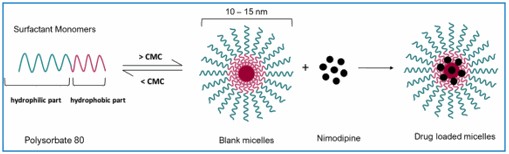
Our lead drug candidate, GTx-104, is a novel injectable formulation of nimodipine for the treatment of aSAH. This formulation offers several potential advantages over oral administration of nimodipine that is the current Standard of Care (SoC) in the United States.
•
Novel injectable formulation of nimodipine
•
Overcomes solubility limitations of nimodipine
•
A patented formulation that uses non-ionic surfactant micelles as the drug carrier to solubilize nimodipine
•
Simple to prepare in a pharmacy and stable at room temperature
Value Proposition
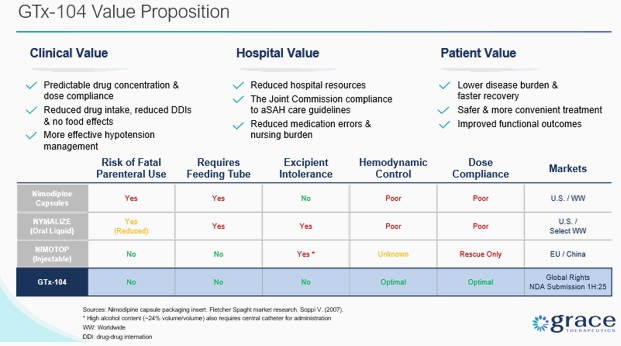
GTx-104 provides a convenient IV delivery of nimodipine in the Intensive Care Unit potentially eliminating the need for nasogastric tube administration in unconscious or dysphagic patients. Intravenous delivery of GTx-104 also has the potential to lower food effects, drug-to-drug interactions, and eliminate potential dosing errors. Further, GTx-104 has the potential to better manage hypotension in aSAH patients. GTx-104 has been administered in over 200 patients and healthy volunteers and was well tolerated with significantly lower inter- and intra-subject pharmacokinetic variability compared to nimodipine oral capsules.
GTx-104 is designed to address significant unmet medical needs for patients with aSAH. We believe that this novel nimodipine IV formulation may offer a potential value to physicians, hospitals, and their patients.
GTx-104 Market Opportunity
Approximately 42,500 patients in the United States are affected by aSAH per year. Company sponsored third party market research including claims analysis suggests that aSAH incidence may be as high as approximately 70,000 per year in the United States. Outside of the United States, annual cases of aSAH are estimated at approximately 60,000 in the European Union, and approximately 150,000 in China.
The unmet needs in the treatment of aSAH patients and the potential of GTx-104 to address the limitations of the current standard of care were the subject of a Key Opinion Leader event we hosted in November 2024. In an independent market research survey we conducted of hospital administrators and critical and neuro intensive care physicians at institutions with Comprehensive or Advanced Stroke Center certification who are involved in purchasing decisions for their institutions/units, respondents reported 80% likelihood of adopting an IV formulation of nimodipine, assuming 100% bioavailability, better safety, no food effects, effective hypotension management, potential hospital value and patient value.
Clinical Data
Pivotal Phase 3 STRIVE-ON Randomized Safety Trial
The STRIVE-ON trial was a prospective, randomized open-label Phase 3 trial of GTx-104 compared with nimodipine oral capsules in patients hospitalized with aSAH. 50 patients were administered GTx-104 and 52 patients received nimodipine oral capsules. The primary endpoint was the number of patients with at least one episode of clinically significant hypotension reasonably considered to be caused by the drug, and additional endpoints included safety, clinical, and pharmacoeconomic outcomes. Each patient was evaluated for up to 90 days inclusive of the 21-day treatment period. There was a higher proportion of the most severe cases of aSAH (Hunt & Hess Grade V) with the worst prognosis in the GTx-104 arm (8%) compared to the nimodipine oral capsule arm (2%).
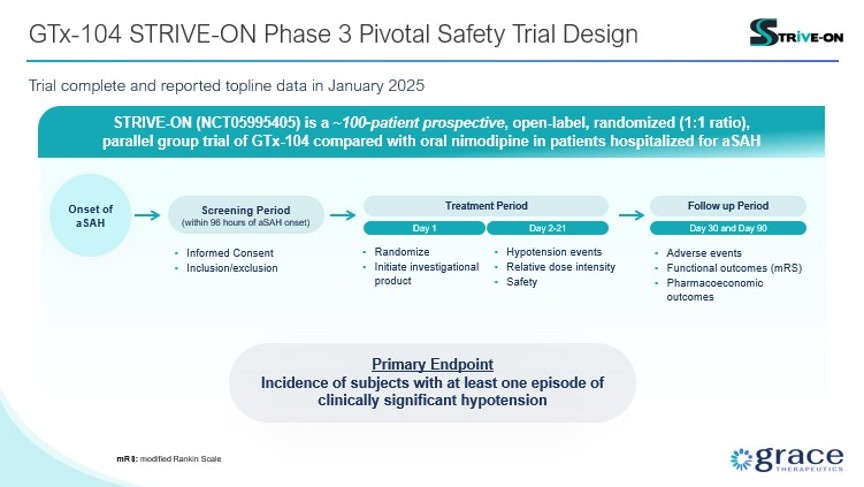
On September 25, 2024, we announced the completion of enrollment in our Phase 3 STRIVE-ON trial for GTx-104. On February 10, 2025, we announced the trial met its primary endpoint and provided evidence of clinical benefit for GTx-104 compared to nimodipine oral capsules. Patients receiving GTx-104 were observed to have a 19% reduction in at least one incidence of clinically significant hypotension compared to nimodipine oral capsules (28% versus 35%). Other measures also favored or were comparable to GTx-104, including:
•
54% of patients who received GTx-104 had a relative dose intensity of 95% or higher of the prescribed dose compared to only 8% on nimodipine oral capsules .
•
29% relative increase in the number of patients receiving GTx-104 compared to nimodipine oral capsules with favorable outcomes at 90 days follow up on the modified Rankin scale. Quality of life as measured by EQ-5D-3L also favored patients receiving GTx-104 versus nimodipine oral capsules .
•
Fewer intensive care unit (ICU) readmissions, ICU days, and ventilator days for patients receiving GTx-104 versus nimodipine oral capsules .
•
Adverse events were comparable between the two arms and no new safety issues were identified with patients receiving GTx-104. All deaths in both arms of the trial were due to severity of the patient’s underlying disease. There were eight deaths on the GTx-104 arm compared to four deaths on the nimodipine oral capsule arm. The survival status of one patient on the nimodipine oral capsule arm was unknown. No deaths were determined to be related to GTx-104 or nimodipine oral capsules.
Furthermore, pharmacoeconomic measures favored the use of GTx-104 for patients with aSAH.
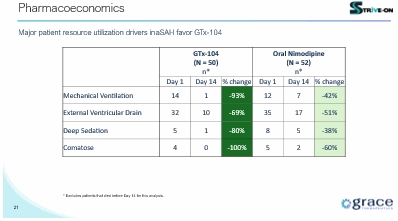
We believe these data validate the GTx-104 value proposition. If approved, GTx-104 has the potential to address significant challenges with nimodipine oral capsule administration and may transform the standard of care for patients with aSAH.
GTx-104 Phase 1 PK Trial
In September 2021, we initiated our pharmacokinetic (“PK”) bridging trial to evaluate the relative bioavailability of GTx-104 compared to currently marketed nimodipine oral capsules in approximately 50 healthy subjects. This PK trial established the 505(b)(2) regulatory pathway for GTx-104.
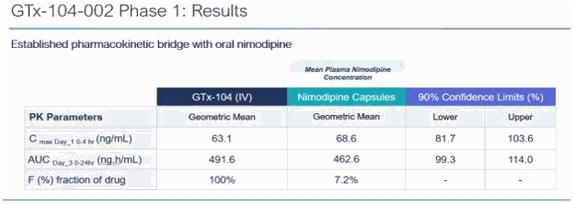
Final results from this PK trial were reported in May 2022, and showed that the bioavailability of GTx-104 compared favorably with nimodipine oral capsules in all subjects, and no serious adverse events were observed for GTx-104.
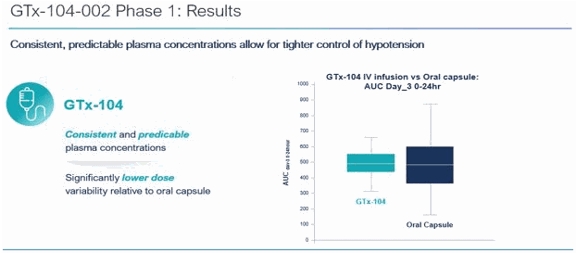
All endpoints indicated that statistically there was no difference in exposures between GTx-104 and nimodipine oral capsules over the defined time periods for both maximum exposure and total exposure. Plasma concentrations obtained following IV administration showed significantly less variability between subjects as compared to nimodipine oral capsules because IV administration is not as sensitive to some of the physiological processes that affect oral administration, such as taking the drug with and without meals, variable gastrointestinal transit time, variable drug uptake from the gastrointestinal tract into the systemic circulation, and variable hepatic blood flow and hepatic first pass metabolism. Previous studies have shown these processes significantly affect the oral bioavailability of nimodipine, and therefore cause oral administration to be prone to larger inter- and intra-subject variability.
The bioavailability of nimodipine oral capsules observed was only approximately 7% compared to 100% for GTx-104. Consequently, about one-twelfth the amount of nimodipine is delivered with GTx-104 to achieve comparable PKs as with nimodipine oral capsules. These data are presented in the chart below.
Regulatory
In April 2025, we announced details of a Type C written meeting response with the FDA. The purpose of this meeting was to obtain feedback on the completed Phase 3 STRIVE-ON safety trial of GTx-104 and our NDA submission, including clinical, non-clinical, and CMC requirements.
In
June 2025, we submitted to the FDA an NDA for GTx-104 for the treatment of
aSAH, which was accepted for review by the FDA in August 2025 with an April 23,
2026, Prescription Drug User Fee Act (“PDUFA”) target date for completing FDA’s
review of our submission. The NDA included clinical results from our STRIVE-ON
trial for GTx-104.
As
previously noted, in April 2026, the FDA issued a CRL in response to our NDA
submission for GTx-104. The CRL referenced certain items in the CMC and
non-clinical sections of the application, which we believe can be addressed in
a resubmission of the NDA. The items cited by the FDA include the cGMP
compliance status of our contract manufacturer. This is a facility-level matter,
and not a GTx-104 product-specific quality finding. The CRL also cited additional
leachables data time points and excipient toxicology risk assessments. The CRL
did not identify any clinical safety or efficacy deficiencies and did not
request additional clinical data. We intend to address each of the CRL items in
our planned resubmission, including completing the required non-clinical
studies.
Following
a Type A meeting with the FDA regarding the CRL, we received the FDA’s official
meeting minutes constituting the official record of the meeting. The plan
described below reflect our planned approach to addressing the items cited in
the CRL following the Type A meeting and our review of the official minutes.
We
have initiated a dual-source manufacturing strategy for GTx-104 to mitigate
potential remediation issues from our
current contract manufacturer and provide flexibility, while continuing to
address the remaining CMC and nonclinical items identified in the CRL. As such,
a technology transfer to a second, U.S.-based contract manufacturer is already
underway. The timing of NDA resubmission will reflect the manufacturing pathway
that reaches readiness first: either (i) the U.S.-based facility, which would
require completion of a full CMC package supported by 12 months of stability
data following the technology transfer; or (ii) our current contract
manufacturer, if it successfully remediates its FDA compliance issues and is
able to support the NDA sooner.
We intend to resubmit our NDA
for GTx-104 for the treatment of aSAH once we have fully addressed the items
cited in the CRL, and plan to report progress as key milestones are achieved.
The timing of any FDA reinspection of the current contract manufacturer is
determined by the FDA and is outside our control.
GTx-102 Overview
GTx-102 is a novel, concentrated oral-mucosal spray of betamethasone intended to improve neurological symptoms of A-T, a rare genetic progressive autosomal recessive neurodegenerative disorder that affects children, for which there are currently no FDA-approved therapies. GTx-102 is a stable, concentrated oral spray formulation comprised of the gluco-corticosteroid betamethasone that, together with other excipients, can be sprayed conveniently over the tongue of the A-T patient and is rapidly absorbed.
We have licensed the data from the multicenter, double-blinded, randomized, placebo-controlled crossover trial from Azienda Ospedaliera Universitaria Senese, Siena, Italy, where Dr. Zannolli et. al. studied the effect of oral liquid solution of betamethasone to reduce ataxia symptoms in patients with A-T. This oral liquid solution is not marketed in the United States and therefore is not available for clinical use. Currently, betamethasone is only available in the United States as an injectable or as a topical cream. This license gives us the right to reference the trial’s data in our NDA filing. On November 12, 2015, we submitted the data from the Zannolli trial to the FDA’s Division of Neurology at a pre-Investigational New Drug (“IND”) meeting and received guidance from the agency on the regulatory requirements to seek approval.
GTx-102 update
As previously disclosed, in May 2023 we made a strategic decision to defer clinical development of GTx-102 to prioritize resources toward GTx-104 and its advancement toward an NDA filing.
In June 2026, following continued evaluation of strategic priorities and focus on GTx-104, we determined we will not resume internal development funding for GTx-102 under our current operating plan. Accordingly, we determined that the remaining carrying value of the GTx-102 IPR&D asset is no longer recoverable on an internal-development basis.
As
of March 31, 2026, the remaining capitalized carrying value of GTx-102 IPR&D
was $9.2 million. We recognized an impairment charge for the full remaining capitalized
carrying value in the first quarter of fiscal year 2027.
Consistent
with our stated position since 2023, we retain all intellectual property and
patent rights associated with GTx-102 and continue to evaluate business
development opportunities, including out-licensing, partnerships, or
non-dilutive arrangements, that would enable advancement of the program without
requiring our direct capital investment. GTx-102 may provide value through such
a transaction. There can be no assurance that any such transaction will be
completed on favorable terms or at all.
GTx-101 Overview
GTx-101 is a non-narcotic, topical bio-adhesive film-forming bupivacaine spray designed to ease the symptoms of patients suffering with Postherapetic Neuralgia (PHN), which is neuropathic pain due to damage caused by the varicella zoster virus. GTx-101 is administered via a metered-dose of bupivacaine spray and forms a thin bio-adhesive topical film on the surface of the patient’s skin, which enables a touch-free, non-greasy application. It also comes in convenient, portable 30 ml plastic bottles. Unlike oral gabapentin and lidocaine patches which are used for the treatment of PHN, we believe that the biphasic delivery mechanism of GTx-101 has the potential for rapid onset of action and continuous pain relief for up to eight hours. No skin sensitivity was reported in a Phase 1 trial.
GTx-101 update
As previously disclosed, in May 2023 we made a strategic decision to defer clinical development of GTx-101 to prioritize resources toward GTx-104 and our advancement toward an NDA filing.
In June 2026, following continued evaluation of strategic priorities and focus on GTx-104, we determined we will not resume internal development funding for GTx-101 under our current operating plan. Accordingly, we determined that the remaining carrying value of the GTx-101 IPR&D asset is no longer recoverable on an internal-development basis.
As of March 31, 2026, the
remaining capitalized carrying value of GTx-101 IPR&D was $4.3 million. We
recognized an impairment charge for the full remaining capitalized carrying
value in the first quarter of fiscal year 2027.
Consistent
with our stated position since 2023, we retain all intellectual property and
patent rights associated with GTx-101 and continue to evaluate business
development opportunities, including out-licensing, partnerships, or
non-dilutive arrangements, that would enable advancement of the program without
requiring our direct capital investment. GTx-101 may provide value through such
a transaction. There can be no assurance that any such transaction will be
completed on favorable terms or at all.
Commercialization Strategy
We have worldwide commercialization rights for all our pipeline drug candidates and plan to maximize the value of each of our drug candidates over time. Currently, we have prioritized the development of GTx-104 over that of GTx-102 and GTx-101. If we receive regulatory approval for GTx-104 in the U.S., we plan to commercialize GTx-104 with a highly experienced and targeted hospital-based sales force. We may seek commercial partnerships to fully exploit the market potential of GTx-104 in the U.S. and in territories outside the U.S. It is possible that we out-license or sell GTx-102 and/or GTx-101 for the U.S. and/or global markets.
Basis of Presentation of the Financial Statements
Our unaudited condensed consolidated financial statements, which include the accounts of our wholly owned subsidiary, have been prepared in accordance with U.S. GAAP and the rules and regulations of the SEC related to quarterly reports filed on Form 10-Q. All intercompany transactions and balances are eliminated on consolidation.
Our assets as of June 30, 2026 include cash and cash equivalents of $13,756 and intangible assets and goodwill of $35,733. Our current liabilities of $1,250 as of June 30, 2026 were comprised primarily of amounts due to or accrued for creditors.
Results of Operations
Comparison of the three months ended June 30, 2026 and 2025
The following table summarizes our results of operations for the three months ended June 30, 2026 and 2025:
(expressed in thousands)
| Three months ended | ||||||||||||
|
June 30, 2026
|
June 30, 2025
|
Increase (Decrease)
| ||||||||||
| $ | $ | $ | ||||||||||
|
Operating expense
|
||||||||||||
|
Research and development expenses
|
697 | 955 | (258 | ) | ||||||||
|
General and administrative expenses
|
1,687 | 2,135 | (448 | ) | ||||||||
|
Impairment of intangible assets
|
13,533 | — | 13,533 | |||||||||
|
Loss from operating activities
|
(15,917 | ) | (3,090 | ) | 12,827 | |||||||
|
Foreign exchange (loss) gain
|
(14 | ) | 10 | (24 | ) | |||||||
|
Change in fair value of derivative warrant liabilities
|
— | (487 | ) | 487 | ||||||||
|
Interest and other income, net
|
141 | 205 | (64 | ) | ||||||||
|
Income tax benefit
|
— | — | — | |||||||||
|
Net loss
|
(15,790 | ) | (3,362 | ) | 12,428 | |||||||
Net Loss
The
net loss of $15,790 or $0.91 per share, for the three months ended June 30,
2026, increased by $12,428 from the net loss of $3,362, or $0.21 per share, for
the three months ended June 30, 2025. The increase in net loss was primarily
due to the $13,533 impairment of IPR&D related to GTx-101 and GTx-102 as further described below. This increase was partially offset by a $487
favorable change in the change in fair value of derivative warrant liabilities,
and a $448 decrease in general and administrative expenses.
Consistent with our previously announced 2023 decision to deprioritize these two programs in favor of GTx-104, and following reevaluation of strategic priorities during the quarter, we recorded a full impairment of the remaining IPR&D carrying value associated with GTx-101 and GTx-102. We also evaluated the carrying value of our IPR&D related to GTx-104 following the receipt of the CRL. Based on the assessment, we determined that the fair value exceeds the carrying amount, and no impairment charge was required for the quarter ended June 30, 2026.
Research and development expenses
Research and development expenses consist primarily of:
•
fees paid to external service providers such as CROs and CMOs related to clinical trials, including contractual obligations for clinical development, clinical sites, manufacturing, technology
transfer costs for CMOs, and scale-up, and formulation of clinical drug supplies; and
•
salaries and related expenses for research and development personnel, including expenses related to equity compensation.
We record research and development expenses as incurred.
Our
research and development during the three months ended June 30, 2026 were
focused primarily on addressing certain items cited in the CRL from the FDA for
our GTx-104 drug candidate. Our research and development during the three
months ended June 30, 2025 were focused primarily on our clinical development
program for our GTx-104 drug candidate and submission of our NDA to the FDA.
The following table summarizes our research and development expenses:
|
(expressed in thousands)
|
||||||||||||
| Three months ended | ||||||||||||
|
June 30, 2026
|
June 30, 2025
|
Increase (Decrease)
| ||||||||||
| $ | $ | $ | ||||||||||
|
Total third-party research and development expenses1
|
408 | 563 | (155 | ) | ||||||||
|
Salaries and benefits
|
258 | 323 | (65 | ) | ||||||||
|
Research and development expense before stock-based compensation and depreciation
|
666 | 886 | (220 | ) | ||||||||
|
Stock-based compensation
|
31 | 69 | (38 | ) | ||||||||
|
Total
|
697 | 955 | (258 | ) | ||||||||
1 Total third-party research and development expenses are calculated before salaries and benefits and stock-based compensation.
Total
research and development expenses for the three months ended June 30, 2026 were
$697, compared to $955 for the three months ended June 30, 2025. The decrease
of $258 was primarily due to a $155 decrease in research activities mainly due
to the completion of our GTx-104 pivotal Phase 3 STRIVE-ON safety clinical
trial and submission of our NDA to the FDA during the prior period whereas the
current period we were only focused on addressing certain items identified in
the CRL from the FDA.
Stock-based compensation of $31 for the three months ended June 30, 2026, decreased by $38 compared to $69 for the three months ended June 30, 2025. The decrease was primarily due to the issuance of new stock option awards during the three months ended June 30, 2025. There were no stock option awards granted during the three months ended June 30, 2026.
General and administrative expenses
General and administrative expenses consist primarily of salaries and related benefits, including stock-based compensation, related to our executive, finance, legal, and support functions, including professional fees for auditing, tax, consulting, rent and utilities and insurance.
(expressed in thousands)
| Three months ended | ||||||||||||
|
June 30, 2026
|
June 30, 2025
|
Increase (Decrease)
| ||||||||||
| $ | $ | $ | ||||||||||
|
Salaries and benefits
|
332 | 479 | (147 | ) | ||||||||
|
Professional fees
|
898 | 871 | 27 | |||||||||
|
Other
|
382 | 550 | (168 | ) | ||||||||
|
General and administrative expense before stock-based compensation and depreciation1
|
1,612 | 1,900 | (288 | ) | ||||||||
|
Stock-based compensation
|
73 | 233 | (160 | ) | ||||||||
|
Depreciation
|
2 | 2 | — | |||||||||
|
Total
|
1,687 | 2,135 | (448 | ) | ||||||||
1 General and administrative sub-total expenses are calculated before stock-based compensation and depreciation.
General
and administrative expenses were $1,687 for the three months ended June 30,
2026, a decrease of $448 from $2,135 for the three months ended June 30, 2025.
The decrease was primarily a result of a decrease in pre-commercial planning
activities for GTx-104 offset in part by increased legal costs related to the
Type A meeting with the FDA, and a decrease in stock-based compensation of $160
due to the issuance of new stock option awards for the three months ended June
30, 2025 with no such issuance occurring for the three months ended June 30,
2026.
Impairment of intangible assets
The
increase in impairment of intangible assets was attributable to our strategic
decision in June 2026 to discontinue development of GTx-101 and GTx-102. As a
result of this decision, we determined that the related capitalized carrying
value of GTx-101 and GTx-102 IPR&D was no longer recoverable and recorded
an impairment charge of $13,533, representing the full capitalized carrying
value of GTx-101 and GTx-102 IPR&D. The impairment charge
was recognized within operating expenses in the condensed consolidated
statements of loss and comprehensive loss for the three months ended June 30,
2026.
Change in fair value of
derivative warrant liabilities
The
decrease in the fair value of derivative warrant liabilities for the three
months ended June 30, 2026 of $487 was attributable to the cancellation of the
warrant liability as the September 2023 private placement common warrants
expired on October 21, 2025, which was the 60th day after the date of the acceptance by the FDA of
the NDA for our product candidate GTx-104.
Interest and other income, net
Interest and other income, net was $141 for the three months ended June 30, 2026, compared to $205 for the three months ended June 30, 2025. The $64 decrease in our interest and other income was due to withdrawals of short-term investments upon their maturity used to fund operations, and a decrease in interest rates.
Liquidity and Capital Resources
Cash flows and financial condition for the three months ended June 30, 2026 and 2025
Summary
As of June 30, 2026, cash and cash equivalents were $13,756, a net decrease of $3,221 compared to cash and cash equivalents of $16,977 at March 31, 2026.
As
described below, in August 2026, we completed a private placement of our Common
Stock with certain institutional and accredited investors. Net proceeds to us
were approximately $9,100. As of August 11, 2026, cash and cash equivalents
were $22,231. We plan to use our cash and cash equivalents towards resolving
the items cited in the FDA’s CRL, working capital and other general corporate
purposes. We believe our existing cash and cash equivalents will be sufficient
to sustain planned operations, including the activities to address the items
cited in the CRL, through the end of calendar 2028.
We will require additional capital to fund our daily operating needs beyond that time. We do not expect to generate revenue from product sales unless we obtain regulatory approval, which is subject to significant uncertainty. To date, we have financed our operations primarily through public offerings and private placements of our common equity, warrants and convertible debt and the proceeds from warrant exercises and research tax credits. Until such time that we can generate significant revenue from drug product sales, if ever, we will require additional financing, which is expected to be sourced from a combination of public or private equity or debt financing or other non-dilutive sources, including fees, milestone payments and royalties from collaborations with third parties. Arrangements with collaborators or others may require us to relinquish certain rights related to our technologies or drug product candidates. Adequate additional financing may not be available to us on acceptable terms, or at all. Our inability to raise capital as and when needed could have a negative impact on our financial condition and our ability to pursue our business strategy. We plan to raise additional capital in order to maintain adequate liquidity. Negative results from studies or trials, if any, or depressed prices of our Common Stock could impact our ability to raise additional financing. Raising additional equity capital is subject to market conditions that are not within our control.
Net cash used in operating activities
Net
cash used in operating activities for the three months ended June 30, 2026 was
$3,221, compared to $1,801 for the three months ended June 30, 2025, an
increase of $1,420. The increase in net cash used in operating activities was
primarily due to changes in trade and other payables of $1,608, prepaid
expenses of $127, offset by changes in fair value of derivative warrant
liability of $487.
Net cash used in investing activities
There were no investing activities for the three months ended June 30, 2026 and 2025.
Net cash used in financing activities
Net cash used in financing activities for the three months ended June 30, 2025 consisted of payment of stock issuance costs of $327. There were no financing activities for the three months ended June 30, 2026.
2026 Private Placement
In
August 2026, we entered into a securities purchase agreement (the “2026
Purchase Agreement”) with certain institutional and accredited investors in
connection with a private placement of shares of our Common Stock (the “2026
Private Placement”). Pursuant to the 2026 Purchase Agreement, we offered and
sold in the 2026 Private Placement an aggregate of 4,761,904 shares of Common
Stock at a purchase price of $2.10 per
share. The net proceeds to us from the 2026 Private Placement were
approximately $9,100, after deducting fees and expenses.
2025 Private Placement
In
February 2025, we agreed to offer and sell in a private placement (the “2025
Private Placement”) an aggregate of 3,252,132 shares of Common Stock, at a
purchase price of $3.395 per share of Common Stock, and pre-funded warrants to
purchase up to 1,166,160 shares of Common Stock, at a purchase price equal to
the purchase price per Share less $0.0001 (the “2025 Pre-Funded Warrants”).
Each 2025 Pre-Funded Warrant is exercisable for one share of Common Stock at an
exercise price of $0.0001 per share, is exercisable immediately and will expire
once exercised in full. For each Share and 2025 Pre-Funded Warrant issued, we
agreed to issue to each purchaser an accompanying common warrant to purchase
shares of Common Stock (or 2025 Pre-Funded Warrants in lieu thereof),
exercisable for an aggregate of 4,418,292 shares of Common Stock (or 2025
Pre-Funded Warrants in lieu thereof) (the “2025 Common Warrants”). Each 2025
Common Warrant is exercisable for one share of Common Stock at an exercise
price of $3.395 per share, is immediately exercisable and will expire on the
earlier of (i) the 60th day after the date the FDA approves the NDA for GTx-104
and (ii) September 25, 2028. The 2025 Private Placement closed on February 11,
2025. The net proceeds to us from the 2025 Private Placement were $13,705,
after deducting fees and expenses.
Contractual Obligations and Commitments
Our contractual obligations and commitments primarily include trade payables, CMO and CRO agreements.
Research and development contracts and contract research organizations agreements
We utilize CMOs for the development and production of clinical materials, and CROs to perform services related to our clinical trials. Pursuant to the agreements with CMOs and CROs, we have either the right to terminate the agreements without penalties or under certain penalty conditions. As of June 30, 2026, we had $95 of commitments to CMOs and $0 of commitments to CROs for the next twelve months.
Contingencies
We evaluate contingencies on an ongoing basis and establish loss provisions for matters in which losses are probable and the amount of the loss can be reasonably estimated.
Use of Estimates and Measurement of Uncertainty
The preparation of these unaudited condensed consolidated financial statements in conformity with U.S. GAAP requires management to make estimates and assumptions that affect the reported amounts of assets, liabilities, income, and expenses. Actual results may differ from these estimates.
Estimates are based on management’s best knowledge of current events and actions that management may undertake in the future. Estimates and underlying assumptions are reviewed on an ongoing basis. Revisions to accounting estimates are recognized in the period in which the estimates are revised and in any future periods affected.
Estimates and assumptions include the measurement of stock-based compensation, derivative warrant liabilities, accruals for research and development contracts and contract organization agreements, and valuation of intangibles and goodwill. Estimates and assumptions are also involved in determining which research and development expenses qualify for research and development tax credits and in what amounts. We recognize the tax credits once we have reasonable assurance that they will be realized.
Critical Accounting Policies
During the three months ended June 30, 2026, there were no material changes to our critical accounting policies from those described in our Annual Report for the year ended March 31, 2026.
A smaller reporting company is not required to provide the information required by this Item.
Disclosure Controls and Procedures
As of the end of the period covered by this quarterly report, our management, with the participation of our Chief Executive Officer and Principal Financial Officer, has performed an evaluation of the effectiveness of our disclosure controls and procedures within the meaning of Rules 13a-15(e) and 15d-15(e) of the Exchange Act. Based upon this evaluation, our management has concluded that, as of June 30, 2026, our existing disclosure controls and procedures were effective. It should be noted that while our Chief Executive Officer and Principal Financial Officer believe that our disclosure controls and procedures provide a reasonable level of assurance that they are effective, they do not expect the disclosure controls and procedures to be capable of preventing all errors and fraud. A control system, no matter how well conceived or operated, can provide only reasonable, but not absolute, assurance that the objectives of the control system are met.
Changes in Internal Control over Financial Reporting
No changes were made to our internal controls over financial reporting that occurred during the quarter ended June 30, 2026, that have materially affected, or are reasonably likely to materially affect, our internal controls over financial reporting.
PART II. OTHER INFORMATION
In the ordinary course of business, we are at times subject to various legal proceedings and disputes. We assess our liabilities and contingencies in connection with outstanding legal proceedings utilizing the latest information available. Where it is probable that we will incur a loss and the amount of the loss can be reasonably estimated, we record a liability in our unaudited condensed consolidated financial statements. These legal contingencies may be adjusted to reflect any relevant developments on a quarterly basis. Where a loss is not probable or the amount of loss is not estimable, we do not accrue legal contingencies. While the outcome of legal proceedings is inherently uncertain, based on information currently available, our management believes that it has established appropriate legal reserves. However, it is possible that the ultimate resolution of these matters, if unfavorable, may be material to our financial position, results of operations, or cash flows. We are not currently a party to any legal proceedings that, in the opinion of management, are likely to have a material adverse effect on our business.
There have been no material changes from the risk factors disclosed in our Annual Report.
None.
None.
Not applicable.
During the three months ended June 30, 2026, no director or officer of the Company adopted terminated
|
Exhibit
No. |
Description
|
|
|
Certificate of Incorporation of Grace Therapeutics, Inc.
(incorporated by reference to Exhibit 3.1 on the Current Report on Form 8-K
filed with the Commission on October 7, 2024)
|
||
|
Certificate of Amendment to the Certificate of Incorporation of
Grace Therapeutics, Inc. (incorporated by reference to Exhibit 3.1 on the
Current Report on Form 8-K filed with the Commission on October 28, 2024)
|
||
|
Bylaws of Grace Therapeutics, Inc. (incorporated by reference to
Exhibit 3.2 on the Current Report on Form 8-K filed with the Commission on
October 28, 2024
|
||
| 10.1† | Consulting Agreement by and between Carrie D’Andrea and the Company, dated June 5, 2026 (incorporated by reference to Exhibit 10.1 on the Current Report on Form 8-K filed with the Commission on June 5, 2026). | |
| 10.2† | Separation Agreement by and between Carrie D’Andrea and the Company, dated June 17, 2026 (incorporated by reference to Exhibit 10.25 on the Annual Report on Form 10-K filed with the
Commission on June 18, 2026). |
|
|
Certification
of Chief Executive Officer pursuant to Rule 13a-14(a) or 15d-14(a) of the
Securities Exchange Act of 1934
|
||
|
Certification
of Principal Financial Officer pursuant to Rule 13a-14(a) or 15d-14(a) of the
Securities Exchange Act of 1934
|
||
|
Certification
of the Chief Executive Officer pursuant to 18 U.S.C. Section 1350, as adopted
pursuant to Section 906 of the Sarbanes-Oxley Act of 2002
|
||
|
Certification
of the Principal Financial Officer pursuant to 18 U.S.C. Section 1350, as
adopted pursuant to Section 906 of the Sarbanes-Oxley Act of 2002
|
||
|
101.INS
|
Inline XBRL Instance Document – the instance document does not
appear in the Interactive Data File because its XBRL tags are embedded within
the Inline XBRL document
|
|
|
101.SCH
|
Inline XBRL Taxonomy Extension Schema With Embedded Linkbase
Documents
|
|
|
104
|
Cover Page Interactive Data File (formatted as Inline XBRL and
contained in Exhibit 101)
|
|
* Filed or furnished herewith
† Indicates a management contract or compensatory plan.
SIGNATURES
Pursuant to the requirements of the Securities Exchange Act of 1934, the registrant has duly caused this report to be signed on its behalf by the undersigned thereunto duly authorized.
|
Dated: August 13, 2026
|
|
|
|
|
|
|
|
|
GRACE THERAPEUTICS, INC.
|
|
|
|
|
|
|
|
By:
|
/s/ Prashant Kohli
|
|
|
|
Name: Prashant Kohli
|
|
|
|
Title: Chief Executive Officer (Principal Executive Officer)
|
|
|
|
|
|
|
By:
|
/s/ Robert DelAversano
|
|
|
|
Name: Robert DelAversano
|
|
|
|
Title: Principal Financial Officer (Principal Financial Officer)
|
38